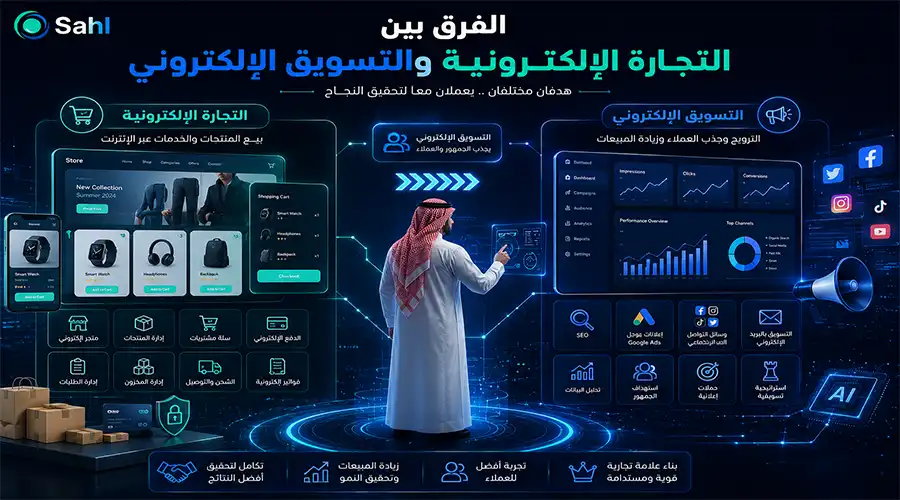



Accurately understanding the difference between e-commerce and digital marketing is the critical first step to ensuring your project’s success in the Saudi market before spending budgets. Many prepare software storefronts and forget how to reach customers, or spend massive budgets on ads while their technical infrastructure is unprepared for conversions! In this guide, Sahl Tech IT provides the essential software and marketing framework to master online sales management and prevent budget waste. The true difference lies in their respective roles: E-Commerce represents the technical infrastructure and integrated ecosystem for displaying products, managing inventory, integrating local payment gateways (Mada, Apple Pay, Tamara, Tabby), and managing e-invoicing compliance with ZATCA. Digital Marketing (E-Marketing), on the other hand, is the promotional and analytical engine that attracts high-intent traffic via social media channels, performance campaigns, search engine optimization, and generative engine optimization (SEO & GEO) to turn visitors into sustainable sales and revenue. The distinction reflects the difference between setting up a storefront and driving its sales engine: e-commerce provides the digital store and cloud infrastructure, while digital marketing drives ready-to-buy visitors and customers directly to it. Ready to elevate your store and scale your sales? Contact the Sahl Tech IT team now, and let us build you a fully integrated store with robust architecture and a marketing plan that ensures market leadership from day one. CTA E-commerce is defined as the software and operational ecosystem designed for buying and selling products or services across digital platforms, processing cloud payments, and managing fulfillment. Driven by advanced infrastructure and government support for digital transformation, e-commerce in Saudi Arabia has become one of the fastest-growing sectors in the Middle East. This sector highlights the sharp contrast between e-commerce and traditional retail in terms of scalability: a merchant in Riyadh, Jeddah, or Dammam can process thousands of concurrent orders without the overhead of opening costly physical showrooms across every region. Digital marketing serves as the compass and primary engine driving liquidity into any digital venture. It is a comprehensive framework of analytical roadmaps and promotional tools designed to acquire customers and maximize Customer Lifetime Value (LTV). Efficient Acquisition & Brand Awareness: Directly reaches high-intent audiences while reducing acquisition costs. Conversion Rate Optimization (CRO): Streamlines user flows across landing pages to minimize drop-offs and maximize revenue. Abandoned Cart Recovery: Retargets incomplete orders with personalized messaging to drive checkout completions. Maximizing Return on Ad Spend (ROAS): Allocates advertising budgets to the highest-yielding channels to eliminate waste. 24/7 Continuous Sales: Automates order intake and payment processing around the clock without operational limits. Lower Overhead Expenses: Cuts retail lease costs, showroom fit-outs, and ongoing facility maintenance fees. Comprehensive Geographic Reach: Expands market footprint across all Saudi regions and internationally in a single click. Automated Invoicing & Workflows: Seamlessly integrates with the ZATCA e-invoicing mandate and automates cloud shipping labels. Flexible Payments & Installments: Deploys local options including Mada, Apple Pay, and Buy Now Pay Later (BNPL) services like Tamara and Tabby. Effortless Software Scalability: Selects flexible architectures capable of sustaining high traffic loads during peak shopping seasons. Granular Audience Targeting: Tailors ads by geographic location, specific interests, and consumer behavioral signals. Real-Time KPI Tracking: Monitors CPC and overall ROI via advanced, centralized performance dashboards. Budget Flexibility: Allows testing through pilot budgets and scaling spend according to verified A/B test results. Sustainable Retention: Uses automated messaging and WhatsApp marketing to drive recurring purchase cycles. Dynamic Retargeting: Displays previously viewed products via interactive ad formats to elevate checkout rates. Discover how Sahl Tech IT elevates your brand through custom digital campaigns and performance optimization. Return to Origin (RTO) & Fulfillment Delays: Last-mile delivery bottlenecks or package refusals on Cash on Delivery orders. Technical Downtime & Latency: Slow page-load speeds during peak seasons leading to lost conversions, highlighting the gap between off-the-shelf platforms and stable, bespoke architectures. Inventory Synchronization: Inventory discrepancies across physical warehouses and digital stores without cloud ERP connectors. Cybersecurity Threats: Data breach attempts and fraud vectors, requiring advanced encryption and enterprise-grade security protocols. Rising Customer Acquisition Costs (CAC): Intensifying ad competition within the Saudi market driving bid prices up. Privacy & Attribution Constraints: The critical need for Server-Side Tracking and Conversion APIs (CAPI) to circumvent browser tracking limits. Ad Fatigue: Creative exhaustion without frequent refresh cycles, reducing engagement and elevating conversion costs. Business-to-Consumer (B2C): Direct sales to individual consumers (such as retail and fashion), characterized by rapid purchasing cycles and heavy reliance on seamless UI/UX and instant checkout. Business-to-Business (B2B): Wholesale supply and enterprise corporate agreements requiring credit terms, purchase orders, and cloud integration with ERP systems. Marketing here relies on SEO and professional B2B channels over influencer campaigns. Supportive Models (C2C & B2G): Consumer-to-consumer mediation portals and approved digital tender platforms serving government entities. Market benchmarks across Saudi Arabia demonstrate that platforms engineered on Custom Microservices & Headless Commerce achieve up to a 35% increase in conversion rates over rigid, off-the-shelf software, driven by sub-second payment responses, custom checkout flows, and real-time API integrations with cloud ERP and ZATCA compliance modules. Build your headless storefront with Sahl Tech IT to secure higher conversions and seamless integrations. CTA Digital marketing is the broader umbrella encompassing both online and offline digital touchpoints (such as interactive DOOH screens and SMS campaigns). E-marketing (Internet Marketing) focuses exclusively on interactive web-based channels (such as SEO, Google Ads, and paid social). Scaling an e-commerce operation requires a technical partner that understands the nuances of the Saudi market and provides deep synergy between bespoke software development and performance marketing: Custom E-Commerce Development: Ultra-fast, lightweight architectures paired with clean UI/UX design to ensure high-speed loading and eliminate the bottlenecks of rigid templates. SEO & GEO Strategy: Dominating search engine results pages and AI-driven answer engines to drive sustainable organic traffic. Paid Media & Performance Management: Running targeted ad campaigns across Snapchat, TikTok, and Meta optimized for maximum ROAS. API & ERP Systems Integration: Connecting storefronts with local payment gateways, logistics partners, and ZATCA e-invoicing frameworks. Request a tailored technical consultation from Sahl Tech IT specialists today to modernize your platform and deploy a strategic growth roadmap. CTA Platform & UX: Streamlined, friction-free checkout flow optimized for all responsive screen sizes. Logistics & Inventory Sync: End-to-end real-time shipment tracking through last-mile delivery. Security & Trust: Hardened data protection via trusted SSL protocols and commercial verification through the Saudi Business Center. Search Engine Optimization (SEO): Building authority to secure reliable, unpaid organic conversion streams. Performance Advertising: Reaching prospective buyers via behavioral and geographic targeting. Lifecycle Marketing & Automation: Maintaining personalized engagement via WhatsApp and email automation to maximize repeat orders.The Difference Between E-Commerce and Digital Marketing: How Do They Integrate?
What Is E-Commerce?
What Is Digital Marketing and Why Is It Vital for Store Growth?
Key Advantages of E-Commerce and Digital Marketing
Key Advantages of E-Commerce:
Key Advantages of Digital Marketing:
Challenges in E-Commerce and Digital Marketing
E-Commerce Operational & Technical Challenges:
Digital Marketing Challenges:
Common E-Commerce Business Models in the Saudi Market
Sahl Tech IT’s Vision for Digital Transformation 2026
What Is the Difference Between Digital Marketing and E-Marketing?
Why Choose Sahl Tech IT as Your Digital Partner in Saudi Arabia?
Storefront Success Factors and Top Marketing Channels
1. Software Infrastructure Fundamentals:
2. High-Impact Marketing Channels:
Frequently Asked Questions