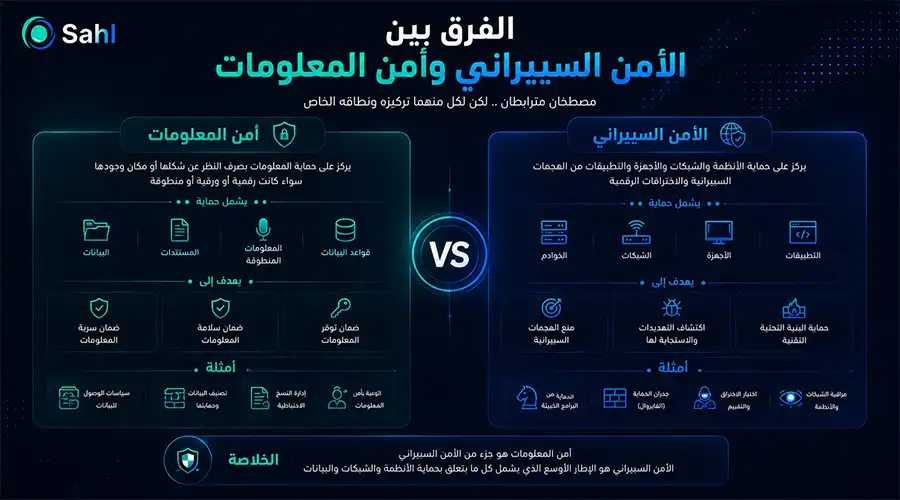


Understanding the difference between cybersecurity and information security is a fundamental step for any organization aiming to protect its assets and data. Many people confuse the two concepts, but in reality, there is a fundamental difference in scope, coverage, and protection methods.
Simply put, Information Security (InfoSec) focuses on protecting data in all its forms—whether physical paper files in your company archives or digital data stored on servers. Meanwhile, Cybersecurity specializes in protecting the digital space and everything connected to networks, the cloud, and systems from the risks of cyber attacks and breaches. Both fields complement each other, but understanding the role of each helps you build a robust defense strategy and ensure business continuity without risks.
In this blog post, Sahl Tech clarifies the difference between cybersecurity and information security, highlights their similarities and differences in detail, and helps you determine which is better suited for your organization or Saudi enterprise. Understanding the difference between information security and cybersecurity helps decision-makers prioritize and allocate budgets effectively without unnecessary waste and costs. Many businesses in the market spend substantial amounts without seeing tangible results because they confuse administrative paperwork policies with technical, on-the-ground protection. At Sahl Tech, we get straight to the point to help you build a secure digital environment and keep operations running seamlessly: Contact Sahl Tech to book a free technical consultation and determine the ideal security setup for your business. CTA The relationship between information security and cybersecurity is not competitive; it is collaborative and inclusive. An organization cannot rely on one without the other. Simply stated, cybersecurity is a core subset under the broader umbrella of information security. Cybersecurity protects the digital dimension of InfoSec: All digital data, databases, and customer records that InfoSec aims to safeguard require cybersecurity to configure firewalls, close vulnerable ports, and deflect external attacks. Policies require technical execution: InfoSec establishes rules and policies (e.g., determining who can access sensitive data), while cybersecurity enforces these rules technically across servers and networks. Enterprise protection is incomplete without both: Having world-class firewalls means little if an employee leaks a sensitive paper document or shares a password over an unencrypted email (InfoSec failure). Conversely, comprehensive written policies cannot protect systems if a server has an unpatched vulnerability exploited by attackers (Cybersecurity failure). In short: Information Security is the brain that plans, classifies, and manages risks, while Cybersecurity is the shield and technical engine that defends and enforces protection on the ground. Sahl Tech helps you bridge this technical gap through managed cybersecurity services that secure your servers, applications, and cloud networks to meet compliance standards without internal recruitment overhead. CTA InfoSec frameworks are grounded in international standards such as ISO/IEC 27001 to ensure asset protection and transactional confidentiality across several domains: Governance, Risk, and Compliance (GRC): Formulating internal policies, aligning operations with local regulatory mandates, and running ongoing risk assessments. Identity and Access Management (IAM): Enforcing the principle of least privilege to restrict sensitive data access to authorized personnel only. Cryptography & Data Loss Prevention (DLP): Utilizing encryption tools to safeguard data in transit and at rest across servers and databases. Physical & Environmental Security: Securing server rooms, data centers, and physical archiving facilities using surveillance and smart access control systems. Business Continuity & Disaster Recovery Planning (BCP & DRP): Developing proactive plans to ensure swift data restoration and uninterrupted operations during unexpected emergencies. Cybersecurity frameworks adhere to rigorous technical standards, such as the Essential Cybersecurity Controls issued by the National Cybersecurity Authority (NCA ECC), across key tracks: Network & Infrastructure Security: Protecting ports and traffic flow using Next-Gen Firewalls and secure connectivity architectures. Cloud & Application Security: Auditing source code for websites and cloud platforms to patch vulnerabilities prior to deployment. Security Operations Center & Monitoring (SOC & SIEM): Continuous 24/7 infrastructure surveillance to detect anomalous activities and neutralize threats in real time. Penetration Testing & Security Assessments: Simulating real-world cyberattacks against systems to uncover and remediate technical flaws. Incident Response: Immediate containment of threats such as ransomware, mitigating blast radiuses, and executing full system recovery. This common question requires reframing: you cannot prioritize one over the other because they are mutually dependent. If your business handles physical paperwork, contracts, and on-premises archives, Information Security is essential for governance, administrative controls, and policy definition. If your operations rely heavily on digital transformation, cloud infrastructures, and internet-facing servers, Cybersecurity becomes an immediate operational priority to prevent digital outages and breaches. A complete defense posture begins with well-defined Information Security policies, executed through advanced Cybersecurity solutions. Sahl Tech provides fully managed cybersecurity services that deliver end-to-end protection for your digital infrastructure while staying compliant with official regulatory frameworks. CTA Conflating IT administration with cybersecurity can expose businesses to critical vulnerabilities. While IT focuses on enablement and availability, Cybersecurity focuses on defense and governance. Information Technology (IT) Team: Focuses on operational enablement, system maintenance, and service availability (e.g., workstation setup, network administration, corporate email support, and system uptime). Cybersecurity Team: Focuses on threat mitigation, governance, and risk auditing (e.g., access control reviews, system hardening, vulnerability assessments, and penetration testing). Combining operational duties and security auditing under a single individual introduces significant operational risk, as implementers should not audit their own work. Partner with Sahl Tech to support your internal IT team with specialized, managed cybersecurity capabilities without the expense of building a dedicated internal security department. CTA Securing your digital infrastructure is no longer a secondary budget item; it is a primary driver of sustainable business continuity in the Saudi market: Securing Remote Work and Multi-Branch Operations: Establishes encrypted communication channels (VPN and Zero Trust) to enable secure remote access to internal resources. Proactive Protection & Early Threat Detection: Real-time SIEM monitoring and intelligent log analysis uncover malicious activity before threat actors can exploit entry points. Supply Chain and Third-Party Security: Protects shared business data among vendors, partners, and cloud providers, eliminating external bridgehead attacks. Reduced Cyber Insurance and Financing Costs: Financial and insurance institutions require proven cybersecurity maturity before extending favorable coverage terms or financing. Ensuring Data Integrity: Prevents unauthorized alteration of financial records and transactional databases, supporting secure integrations like ZATCA e-invoicing compliance. The Saudi market maintains strict regulatory frameworks to safeguard national cyberspace and data privacy: Avoiding Regulatory Fines: Prevents severe penalties associated with data breaches or non-compliance with mandatory data privacy frameworks (such as the Personal Data Protection Law - PDPL). Qualifying for Enterprise Projects and Tenders: Demonstrating compliance with standard controls is a prerequisite for government bids and enterprise procurement (e.g., Aramco, SABIC, and financial institutions). Audit Readiness: Maintaining documented access control and change management records facilitates seamless internal and external compliance audits. Issued by the National Cybersecurity Authority, ECC serves as the baseline regulatory framework covering five main pillars: Cybersecurity Governance: Executive-mandated policies, defined RACI matrices, and continuous risk management. Cybersecurity Defense: Hardening networks/servers, IAM policies, MFA deployment, and mandatory cryptographic standards. Cybersecurity Resilience: Documented Disaster Recovery Plans (DRP), isolated backups, and periodic restoration tests. Third-Party & Supply Chain Security: Assessing and monitoring third-party risk prior to system integrations. Cloud Computing & Application Security: Security by Design, DevSecOps, and rigorous code reviews. Sahl Tech helps identify infrastructure gaps, implement NCA ECC mandates, conduct penetration tests, and secure cloud environments. CTA High Operational and Recruitment Costs: High market demand and salary expectations for specialized cybersecurity talent, along with expensive enterprise tooling licenses. Administrative Complexity: Siloed tools cause alert fatigue and obscure unified risk visibility without a 24/7 monitoring capability. Conflating IT with Security: Overburdening IT staff with security auditing creates unmonitored blind spots. Overlooking Insider Risks and Vendor Exposure: Over-relying on perimeter firewalls while neglecting internal access governance and vendor vetting. Vulnerability Assessments & Penetration Testing: Identify and remediate flaws across web platforms, applications, and networks. Cloud & Server Security Management: 24/7 monitoring to isolate malicious behavior and defend databases against compromise. Alignment with National Frameworks (NCA ECC & PDPL): Seamlessly implement required security controls alongside your internal IT staff. Choosing a managed security services model can reduce the operational cost of building an in-house security department by up to 60%. Network architecture comprehension and data flow analysis. Identity and Access Management (IAM) governance. Procedural security gap analysis and auditing. Data protection management, cryptography, and DLP tool administration. Security awareness training against social engineering and phishing tactics. Log analysis, threat hunting, and intrusion detection. Security incident response, malware containment, and system recovery. Threat intelligence tracking and modern adversary tactics (TTPs). Application security, code auditing, and vulnerability exploitation mechanics. Hands-on proficiency with SIEM, EDR, and offensive security tooling.What is the Difference Between Cybersecurity and Information Security?
The Relationship and Overlap Between Information Security and Cybersecurity
Key Domains of Information Security
Key Domains of Cybersecurity
Which is Better: Cybersecurity or Information Security?
Difference Between Information Technology (IT) and Cybersecurity
Business Benefits of Implementing Cybersecurity and InfoSec Solutions
Regulatory Compliance (NCA ECC / ISO 27001)
Essential Cybersecurity Controls (ECC) | NCA
Common Challenges in Security Implementation and Mitigation Strategies
How to Overcome These Challenges with Sahl Tech:
Required Skills for InfoSec vs. Cybersecurity Professionals
Information Security Skills:
Cybersecurity Skills:
Frequently Asked Questions (FAQ)