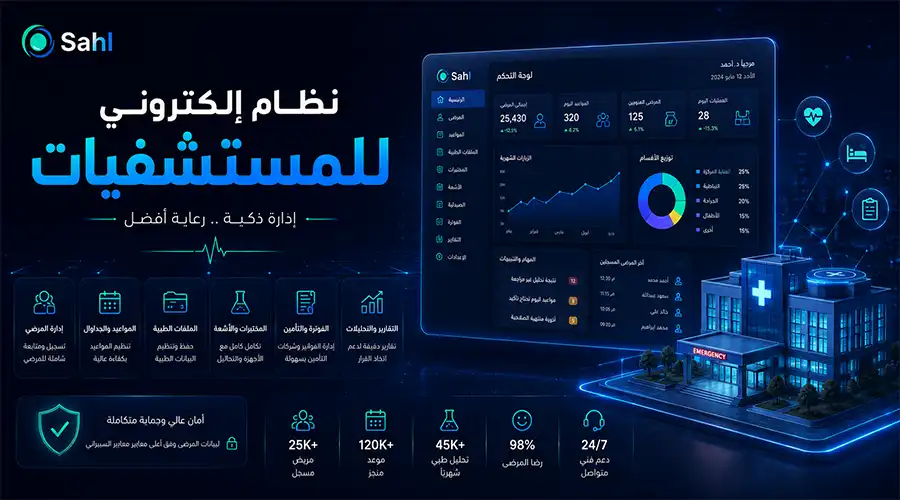



Building an electronic hospital system is an inevitable strategic step for any medical facility striving for leadership and operational development in the Kingdom of Saudi Arabia. With the acceleration of digital transformation under Vision 2030, this system ensures the automation of daily operations, the reduction of human error, and the elevation of healthcare efficiency, which directly translates to reduced costs and increased revenues.
Explore in this article your comprehensive guide to digital transformation; starting from the technical components of the system and the types of electronic hospital systems, to the implementation steps and the fundamental difference between electronic and traditional systems. This will empower you to make a sound investment decision that guarantees compliance with the Ministry of Health's standards and multiplies your operational profits.
What is an Electronic Hospital System?
An electronic hospital system is an integrated technology platform specifically designed to automate all operational, administrative, and medical processes within healthcare facilities. This system aims to unify databases into a single digital interface that allows medical administration and clinical staff to efficiently track real-time workflows.
By relying on secure cloud or on-premise infrastructure, the system minimizes human intervention, prevents medical errors, and elevates the quality of patient care in accordance with the strict health standards in the Kingdom.
Components of an Electronic Hospital System
Any advanced technical system consists of interconnected software modules that work together to ensure seamless operations. The core components include:
- Reception and Patient Affairs Module: Primarily relies on a medical appointment booking and admission system to accurately schedule visits and organize waiting rooms.
- Clinical Medical Records Module: Represented by the Electronic Medical Record (EMR) system, which stores patient history, lab results, and radiological images for every patient.
- Pharmacy and Inventory Module: Monitors medication flow and alerts management when supplies are low to ensure no service interruptions.
- Accounting and Billing Module: Issues electronic invoices compliant with the Zakat, Tax and Customs Authority (ZATCA) and tracks payments.
Contact the experts at Sahltech IT for website and application development via WhatsApp at +966533879965 or email support@sahltechit.com for a technical consultation and an accurate, customized quote for your project. We are here to build you an advanced medical system that ensures full compliance with Saudi Ministry of Health standards and achieves the highest return on investment.
CTA
Types of Electronic Hospital Systems in the Saudi Market
The technical system for healthcare facilities is divided into several categories based on infrastructure (hosting) and the size of operational units. The following table highlights the most prominent options available to support your investment decision:
| System Type | Description and Key Features | Targeted Medical Category |
| Cloud-Based Systems | Flexible and secure hosting that meets cybersecurity standards (PDPL), ensuring easy integration of the appointment booking and admission system for real-time data access. | Centers and hospitals seeking operational flexibility and low startup costs. |
| On-Premise Systems | Establishing internal physical servers for absolute data control. This is the classic choice for building a Hospital Information System (HIS) in Saudi Arabia. | Major medical cities and hospitals with high budgets and a need for digital independence. |
| Electronic Medical Record (EMR) System | A module dedicated to automating medical history and radiology. The EMR system accurately prevents medical errors and drug interactions. | Specialized clinics, operating rooms, and precision diagnostic centers. |
| Clinic Management System (CMS) | Represents a miniature hospital management system; includes initial billing tools, patient scheduling, and internal pharmacy inventory management. | Day-surgery complexes and medium-sized dispensaries. |
| Comprehensive Administrative Systems (ERP) | A massive platform that links clinical and financial departments together, providing a robust infrastructure to manage insurance and medical claims electronically via the "Nafis" platform. | Comprehensive central hospitals requiring complex accounting and medical integration. |
| Integrated Digital Growth Systems | Operational systems supported by digital expansion plans, where the platform is integrated with comprehensive marketing packages including content, advertising, and analytics. | New medical facilities aiming to quickly acquire a leading market share. |
Are you feeling confused about the most suitable technical architecture for the size of your medical facility? Don't let software complexities hinder your business growth. Contact the experts at Sahltech IT for website and application development today to get a precise technical consultation. We are here to help you make the right decision and design a scalable technical system that supports your vision.
CTA
The Importance of an Electronic Hospital System
For decision-makers and investors in the healthcare sector, the importance of this strategic shift can be summarized in the following core points:
Elevating Clinical Care Quality: The EMR system is the cornerstone of protecting patient lives. It provides the doctor with an instant dashboard displaying accurate medical history, previous test results, and real-time warnings for drug interactions, reducing the probability of medical errors to nearly zero.
Eliminating Financial Waste and Accelerating Collection: Many hospitals lose a significant portion of their revenue due to paperwork errors. By activating dedicated tools for managing insurance and medical claims electronically, the approval cycle is accelerated, and the rejection rate from insurance companies is minimized through automated, encrypted linkage with the "Nafis" platform.
Engineering an Exceptional Patient Experience: A positive impression begins before the patient even arrives at the clinic. Providing a digital medical appointment and admission system permanently eliminates waiting lines and crowding in reception halls, raising patient satisfaction and loyalty to the facility.
Tight Administrative and Operational Integration: Implementing a comprehensive hospital management system ensures a seamless flow of information between all departments. From the moment of check-in, through dispensing medications from the central pharmacy based on automated inventory alerts, to issuing the final invoice, the process is done with extreme accuracy and without duplicating employee effort.
Strict Compliance with Government Regulations: Establishing a HIS in Saudi Arabia ensures full compliance with the requirements of the Ministry of Health and the National Cybersecurity Authority, protecting the facility from heavy legal fines related to the leakage or loss of sensitive patient data.
Supporting Commercial Expansion and Growth Decisions: Digital systems generate smart reports on medical staff performance and the most profitable clinics. Based on these indicators, budgets can be intelligently directed toward comprehensive marketing packages (content, ads, analytics) to reinforce strengths and effectively attract new patient segments.
Investing in this digital ecosystem is the true dividing line between traditional medical centers threatened by stagnation and pioneering healthcare entities leading the future of medical digital transformation in Saudi Arabia.
Pros and Cons of an Electronic Hospital System
Adopting digital transformation and establishing an electronic hospital system is a strategic decision that carries massive investment and operational returns, but it also requires full awareness of the accompanying technical challenges.
Pros of an Electronic Hospital System
Medical Data Accuracy: The system prevents overlapping prescriptions and automatically warns the doctor of drug interactions thanks to the EMR system.
Advanced Financial Integration: Provides specialized tools for electronic insurance and claims management, speeding up the financial collection cycle and reducing claim rejections from insurance companies (Nafis).
Enhanced Patient Experience: Allows patients easy access to the facility's services by enabling appointment booking and admission through mobile applications linked to the central system.
Smart Reporting: Issues periodic performance reports highlighting the most profitable clinics and real-time physician performance rates.
Cons of an Electronic Hospital System
Despite the immense benefits, investors face some challenges that can be overcome with proper planning:
Resistance to Change: Some medical staff members may find it difficult to transition from paper to digital workflows. This is resolved by providing intensive training sessions.
Startup Costs: The required development budget might seem like an initial hurdle, but the return on investment covers this cost within the first few months of full operation.
Cybersecurity Risks: Medical systems demand maximum protection. This challenge is overcome by contracting a reliable software company that applies modern encryption protocols to ensure the stability of the hospital management system and protect records.
Don't hesitate—start your facility's digital transformation journey today with Sahltech!
CTA
Cost of an Electronic Hospital System in Saudi Arabia 2026
The budget for establishing a medical ecosystem is not a random number; it undergoes precise engineering and financial study. The final cost of developing and building the project is influenced by several key technical and operational factors:
Number of Software Features (The Main Price Driver): Cost is calculated based on a strict and transparent engineering formula: (Number of requested features × 350 SAR).
Technical Integration and APIs: The cost varies based on the scale of integration with external entities, such as activating tools for electronic insurance and claims management and encrypting their connection with "Nafis" and ZATCA.
Infrastructure and Hosting Type: The budget for hosting an EMR system on flexible cloud servers differs from the hefty cost of setting up physical, on-premise servers inside the hospital building.
Supporting Operational and Marketing Services: The budget is affected by the facility's desire to utilize integrated marketing packages (content, ads, and analytics) to ensure patient influx and rapid revenue growth immediately after the system's launch.
These factors are inevitable investment tools that guarantee you build a hospital management system with high engineering efficiency, without randomly draining your operational budget. Let us build you an unbeatable system... Call us today for your custom quote!
CTA
Suitable Facilities for an Electronic Hospital System
The use of this system is not limited to major hospitals alone; it is the necessary infrastructure for:
Public and private hospitals of all sizes.
Comprehensive medical clinic complexes (dispensaries).
Day-surgery centers and cosmetic clinics.
Medical analysis laboratories and advanced radiology centers.
To ensure the commercial success of these facilities, the operational system is usually supported by contracting integrated marketing packages (content, ads, and analytics) to increase visit rates and achieve sustainable growth. In short, any medical facility dealing with patient health, financial, and insurance data is an ideal and indispensable environment for implementing a hospital management system to ensure efficiency, sustainable expansion, and compliance with Ministry of Health requirements.
Steps to Implement an Electronic Hospital System
Transitioning from paper-based management or dilapidated legacy systems to a fully automated digital environment requires precise technical engineering and a clear roadmap. It’s not just about installing off-the-shelf software; it goes through calculated development phases ensuring the system fits the facility's workflow.
System Analysis & Requirements Gathering: Studying the hospital's current document cycle, identifying the required software modules, and accurately calculating its engineering budget.
UI/UX Design and Development: Programming user-friendly interfaces for both doctors and reception staff, and establishing the central database.
Core Module Development: Programming the medical appointment booking and admission system as the primary reception unit, and developing clinical records to document cases.
Network Integration: Linking the system to Saudi digital payment gateways and activating electronic insurance and claims management tools with approved entities.
Beta Testing and Field Training: Launching the system in a test environment to check performance, in parallel with training medical staff on effective usage.
By following this strict engineering methodology, the medical facility ensures a safe and seamless transition to a HIS in Saudi Arabia without any interruption to daily operations or loss of previous patient data.
How to Use an Electronic Hospital System ?
Modern system interfaces are designed to be intuitive and rely primarily on "Role-Based Access" to ensure rapid task completion and protect data confidentiality. Here is a workflow that ensures investors a smooth daily operation at the highest professional standards:
Swift Reception: The clerk begins by registering the patient via the appointment booking and admission system, directing the patient straight to the relevant clinic without the need to open paper files or create waiting lines.
Automated Clinical Diagnosis: The doctor opens their screen to find the EMR system displaying the full medical history. They enter the diagnosis and prescribe medication with the click of a button, transferring the data instantly.
Instant Dispensing and Billing: The prescription automatically reaches the pharmacy screen, simultaneously activating the electronic insurance and claims management tools to verify coverage with the "Nafis" platform and issue the final invoice immediately.
Administrative and Marketing Oversight: Senior management monitors performance via the hospital management system's dashboard. By analyzing this data, budgets can be directed toward integrated marketing packages (content, ads, and analytics) to reinforce strengths and attract new demographics.
This professional, simplified usage gives you, as a business owner, total control over operations and cash flows through a single screen, maximizing your profits and ensuring sustainable operational efficiency.
The Difference Between Electronic and Traditional Hospital Systems
We demonstrate the fundamental difference between establishing an electronic hospital system and relying on a traditional system in the following table. Clinging to traditional methods opens the door wide to financial waste and human error, while comprehensive digitization guarantees the investor total control over all operational processes.
| Operational Comparison Aspect | Traditional / Paper Administrative System | Modern Electronic Hospital System |
| Medical Records Retrieval | Very slow, with a high probability of file loss or damage and overlapping drug prescriptions. | Instant retrieval with the click of a button via the EMR system, featuring automated alerts to prevent medical errors. |
| Financial and Insurance Procedures | Manual and complex, leading to higher claim rejection rates and delayed cash flows from insurance companies. | Full automation that allows electronic management of insurance and medical claims, directly linked with the "Nafis" platform to ensure rapid collection. |
| Appointment Booking and Reception | Relies on physical presence or phone calls, creating frustrating waiting lines and crowding. | Automated, seamless organization through the appointment booking and admission system, providing a smooth and comfortable patient journey. |
| Commercial Growth and Marketing | Relies purely on reputation without accurate data to analyze clinic performance or identify target demographics. | Provides smart reports that guide your budget toward integrated marketing packages (content, ads, and analytics) to attract new segments. |
| Compliance with Saudi Regulations | Extreme difficulty in applying security standards and updating data according to new Ministry of Health regulations. | Complete and automated compliance when establishing a HIS in Saudi Arabia with cybersecurity and Personal Data Protection Law (PDPL) standards. |
Clinging to legacy systems in the era of speed and digital transformation exposes the facility to a declining reputation and heavy financial losses. We guarantee a transition that does not hinder your daily workflow, placing your facility at the forefront with digital services worthy of the Saudi market's aspirations. Book your technical consultation with us today and start your era of leadership!
CTA
Top Tips for a Successful Electronic Hospital System
To ensure the success of this radical transformation, here are the most important practical and technical tips for decision-makers:
Focus on User Experience (UI/UX): The medical staff's response speed relies entirely on interface simplicity. The appointment booking and admission system must be designed with interactive, uncomplicated interfaces to speed up patient registration and prevent crowding, positively reflecting on operational efficiency and patient satisfaction.
Secure Integration with Government Regulations: The success of any hospital management system in the Kingdom is measured by its compliance with regulations. Ensure full compatibility and encrypted linkage for electronic insurance and claims management with the Council of Health Insurance platform (Nafis) to guarantee stable cash flow and avoid financial rejections.
Continuous Training to Break Human Resistance: High technology loses its value without qualified staff. Allocate regular workshops and practical training for doctors on the rapid use of the EMR system to ensure medical records are accurately updated without disrupting daily clinic workflows.
Flexibility and Engineering Scalability: The system must be built on software architecture that allows for the easy addition of new departments and features as the facility grows.
Investing in the Facility's Digital Reach: A successful system needs a steady stream of patients to maximize its capacity. It is always recommended to synchronize the launch of a HIS in Saudi Arabia with the activation of integrated marketing packages (content, ads, and analytics) to enhance your medical brand's digital presence and educate the public on the advanced services available.
Don't let your medical facility fall behind in development and lose its market share. Contact the expert team at Sahltech IT today. Reach out to us now and propel toward the top!
CTA
Best Companies for Implementing Electronic Hospital Systems - Sahltech IT
Successfully launching an electronic hospital system is not just about buying code; it requires contracting a technical consulting entity with a deep understanding of the complexities of Ministry of Health compliance and cybersecurity requirements. Here, Sahltech IT leads the scene as the primary strategic choice for building integrated medical systems.
Sahltech IT Features
Sahltech IT pioneers this sector through the following advantages:
Fully Custom Design: We completely move away from ready-made templates and develop the hospital management system from scratch to perfectly align with the workflow mechanisms inside your medical complex.
Legally Compliant Security: Secure local hosting and maximum protection that meet the National Cybersecurity Authority’s requirements and strictly adhere to the Personal Data Protection Law (PDPL).
Medical Cycle Automation: Precise integration of the appointment booking and admission system with the EMR system to simplify tasks for doctors and reception staff.
Smart Insurance Connectivity: Building gateways for electronic insurance and claims management through direct, authenticated API links with the Nafis platform to accelerate your financial cycle and reduce rejections.
Fair Pricing Policy: We commit to a strict, transparent engineering pricing formula; if your facility requires 40 advanced operational features, the cost is calculated as follows: (40 features × 350 SAR) = 14,000 SAR to develop the core infrastructure.
Reputation Building and Digital Attraction: We provide ERP, POS, and CRM business management solutions to help you attract patients, achieve market dominance, and grow rapidly.
Are you looking for a tech partner who understands the complexities of the medical sector and protects your investments? Overcome the hurdles of digitization and secure a leading position for your medical facility. Contact the Sahltech expert team now to analyze your requirements and design a secure, well-thought-out roadmap.
CTA